



If you’ve been a FAN reader over the last six years, you know the Summer Meeting is one of our favorite events to cover. AOFAS heads to the Pacific Northwest with a sold-out exhibit hall, 99 companies and attendance already approaching 1,200.
In this pre-meeting issue, we’ll dig deep into TTT (Transverse Tibial Transport) and ask whether it could be the next industry gold rush before introducing you to one of the Little Guys willing to take a fresh look at an old idea.
Finally, we’ve rounded up the AOFAS industry labs with faculty details and registration links, giving you a quick look at what the companies will be showcasing in Seattle. If you’re headed to the meeting, sign up and get your hands dirty!
Grab a latte and dig in.
As always, we’re grateful for all of our FANS. Our subscriber list has grown to more than 24,000, and we’ve updated FootandAnkleNews.com with some of our favorite stories from years past. We’ll continue adding new issues as they’re published.
Questions, comments, tips or something we should know?
Golden Demobone: Social Media Education Award
This Golden Demobone is the first of its kind — and probably long overdue
We’ve never given the award to a LinkedIn educator before. Something tells us it won’t be the last.
This week’s winner is a man of the independent rep. His posts consistently highlight some of the newer technologies coming from the smaller guys in foot and ankle — with excellent video editing, thoughtful implant rationale, and a dash of patient follow-up. Congrats to Dr. William Crawford, MD on this weeks Golden Demobone Award.
In the featured post, he combines the TendMin MIS Achilles device with CONMED BioBrace and walks through the case from technique to outcome.
This is exactly the kind of content we like to see: useful, educational, and willing to shine a light on technology that doesn’t always have a massive marketing machine behind it.
Take a look at the post and give the man a follow
FAN Jams: Playlists of the Foot & Ankle
Seattle. AOFAS.
It had to be grunge.
Dr. Anand Vora takes over FAN JAMS with a playlist built for the Pacific Northwest — Pearl Jam, Nirvana, Soundgarden, Alice in Chains and a few others from the era that put Seattle on the musical map.
Whether you're headed to Seattle, hammering cases back home or just need something better coming through the speakers when enjoying your favorite newsletter, turn it up.

You Down with TTT?
Every few years, Foot and Ankle catches a wave.
Total ankle replacement changed the conversation around end-stage ankle arthritis, and it has evolved considerably over the last decade. STAR to SALTO and INBONE to INFINITY, and now trending back toward intramedullary tibial fixation with several new companies entering the market. Literature and clinical results drove adoption, and industry hammered it home.
Then MIS came back. Techniques improved, surgeons got interested, companies got interested, products followed, training followed and sales followed. Every company is burning marketing dollars to grab its piece of the MIS market.
Which raises an interesting question: Does the data drive the change — or does industry help drive the change?
Probably both, especially when the data supports new market growth.
Which brings us to TTT.
Move the Bone, Heal the Wound?
Transverse tibial transport is a limb-salvage technique based on distraction osteogenesis principles.
Instead of lengthening the tibia longitudinally, a segment of tibial cortex is gradually transported transversely. The theory - and increasingly the clinical interest - is that the process stimulates angiogenesis, improves local perfusion and helps create an environment capable of healing wounds that otherwise haven't healed.
Think diabetic foot wounds, compromised circulation, failed treatments and patients getting uncomfortably close to amputation. That's why people are paying attention.
Does It Work?
Maybe. And that's what makes this interesting.
There is a meaningful body of published experience, much of it coming from China, showing encouraging results in difficult diabetic-foot and limb-salvage populations. Reported outcomes include improved wound healing, perfusion and limb salvage.
But the evidence isn't finished. Much of the published literature consists of cohorts, retrospective studies and case series rather than the kind of large randomized trials that make everyone comfortable.
FAN has curated the TTT literature and built a dedicated reference library for anyone who wants to dig deeper — check it out here.
So we have an interesting clinical signal. We also have industry moving.
Who's Already In?
- Orthofix — TrueLok Elevate TTT
- Vilex — Dynex Triad
- Paragon 28 — Spider Monkey TTT
- Biodynamik — XT3
- Blue Ocean — Excelsior / Fastr
- Ortho Solutions (distribution deal) — Cybion
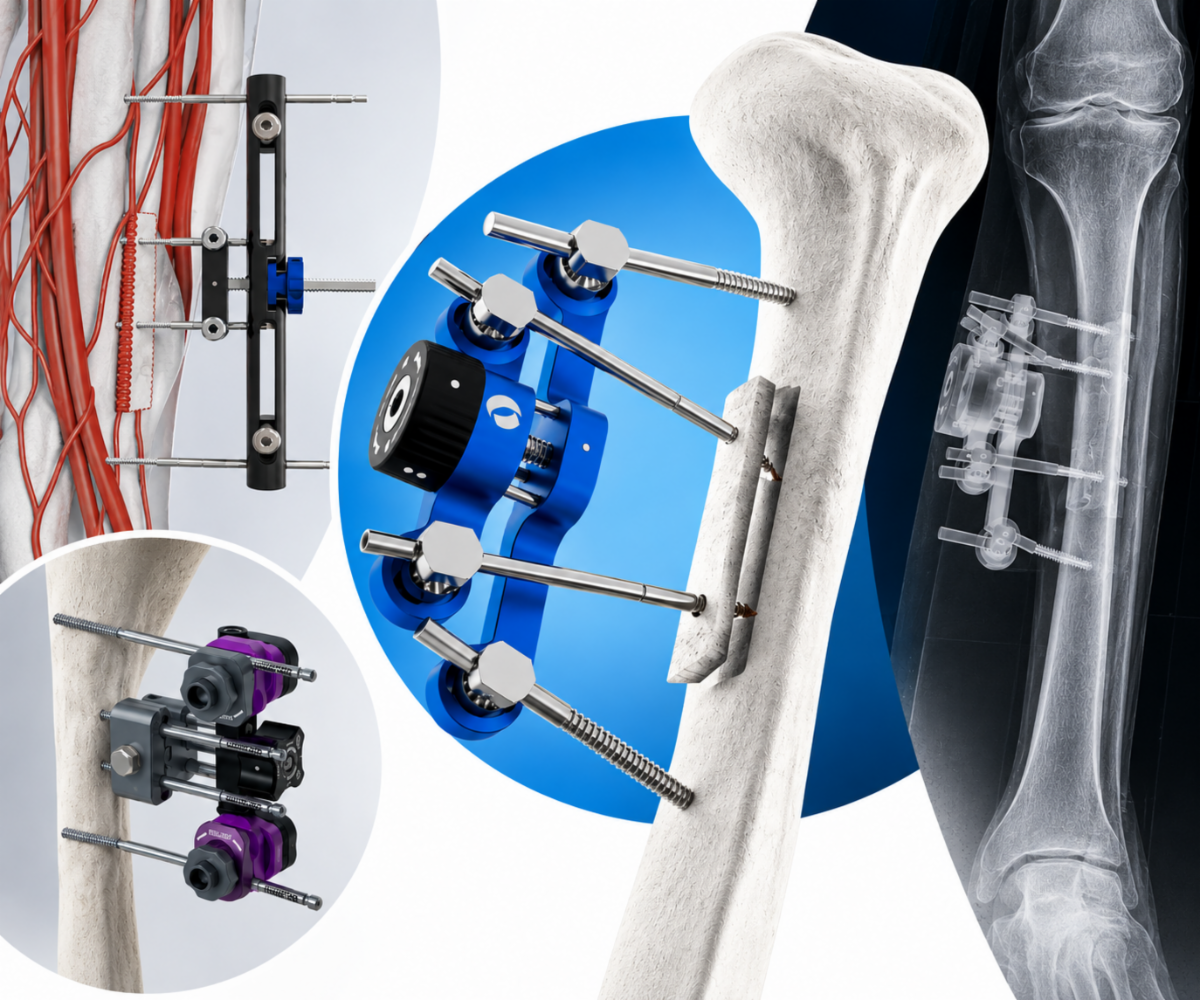
Six players already. Research yourself right now, we will do a deep dive in a future issue on the individual systems.
The Marketing Problem
Here's where TTT gets interesting.
The reason most of us are talking about transverse tibial transport is chronic wounds and limb salvage. But that's not actually what these devices are FDA-cleared to treat.
Look at the current U.S. systems and you'll find indications for things like bone transport, nonunion, pseudoarthrosis and the correction of bony or soft-tissue defects. What you won't find is diabetic foot ulcers, chronic wounds or nonhealing wounds.
That creates an unusual marketing problem.
The literature can talk about diabetic foot ulcers. Surgeons can talk about what they're seeing. Scientific meetings can discuss TTT for limb preservation. And FAN can certainly talk about the published data.
But the companies selling the devices have to be much more careful about how they promote them.
So we have a new product category where the clinical application generating most of the buzz is also the application manufacturers can't simply put on the booth banner.
That's going to make AOFAS interesting.
Why Industry Will Like TTT
Let's not pretend the commercial side doesn't matter.
Limb $alvage is already an expensive episode of care. These patients may undergo debridement, biologics, wound products, negative-pressure therapy, fixation and multiple procedures.
TTT potentially adds another specialized technology to that treatment pathway. It doesn't necessarily have to replace everything else. It can sit alongside it.
If clinical adoption grows, that makes TTT an attractive category for orthopedic companies - particularly companies that already have external-fixation platforms, limb-reconstruction sales forces and relationships with the surgeons treating these patients.
The DPM Problem
There is one potential speed bump nobody should ignore: scope of practice.
Podiatric surgeons make up a massive part of the diabetic foot and limb-salvage market. But TTT requires operating on the tibia, and how far up the tibia a DPM can operate varies by state, training, privileges and facility.
That matters.
The procedure can be performed more distally, but a technology aimed at diabetic foot wounds has an obvious commercial limitation if a meaningful percentage of the surgeons treating those wounds can't perform the procedure — or can't perform it in the same way — because of where the corticotomy and fixation need to be placed.
This isn't necessarily a deal-breaker. But if TTT is going to become a major U.S. limb-salvage category, the DPM scope question is something companies are going to have to navigate.
And it gives product developers one more reason to start thinking smaller and more distal.
What's Next?
MIS TTT. Of course. A foot and ankle marketer's dream!
These patients have compromised soft tissue and terrible healing potential, and we're creating an incision to improve their healing potential. You don't need to be a genius to see where this eventually goes: Smaller incision. Better targeting. Easier corticotomy. More reproducible instrumentation.
So here's some free product-development advice: Skip Gen 2. Go straight to Gen 3 before Gen 2 gets here.
Final Take
We’re ready to call it: TTT is going to be the next gold rush.
Maybe not in case volume, but in the way the category is about to develop. The clinical concept is fascinating, the early results are compelling, the patient population desperately needs better options, and six companies already have systems creating the interest as the big boys sit and watch.
And remember who this patient often is: the recalcitrant wound that has already been through debridement, revascularization, biologics, skin substitutes and everything else in the limb-salvage bag — with a BKA becoming the next conversation. If there is another reasonable option before losing the leg, surgeons are going to look at it.
The potential roadblock may be who can perform it. TTT requires working on the tibia, which could limit adoption among DPMs depending on state scope-of-practice rules. In a market where podiatrists manage a tremendous amount of diabetic foot disease, that matters.
But maybe we’re thinking too narrowly anyway.
The bigger story may eventually be TBT — transverse bone transport – coined by ORTHOFIX. The concept doesn’t necessarily begin and end with the tibia, the diabetic foot, or even the lower extremity. If the biologic effect of bone transport can be translated to other difficult wounds and anatomic locations, this becomes a much bigger conversation than another foot-and-ankle device category.
Which leaves us with the same question we started with: Does the data create the market, or does the market help create the data?
With TBT, we may get to watch the answer in real time. Our prediction is that every major foot and ankle company will have a transverse bone transport product within the next 12 to 18 months. Let the games begin!
Little Guy, Big Idea: Don’t Call It a Comeback
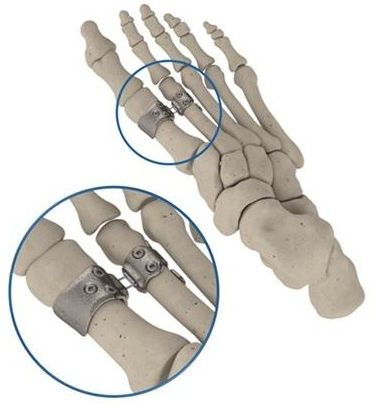
HyperFlex is a bunion correction system that requires no osteotomy or fusion. It uses #5 suture between low-profile plates on the first and second metatarsals to hold the correction.
If you’ve been around foot and ankle for a minute, this story may sound familiar.
Arthrex introduced the Mini TightRope nearly 20 years ago, back when its foot and ankle business was in its infancy. There was nothing quite like it. It was groundbreaking, it had its doubters and it had a few champions. But complications ultimately limited adoption, and the concept is now looked at as more of an adjunct procedure.
So HyperFlex knows exactly what the first question is going to be:
Wait…isn’t this the Mini TightRope all over again?
They’ve built their first line of defense around why they believe it isn’t. Unlike the old transosseous construct, HyperFlex doesn’t drill a tunnel through the first and second metatarsals. Low-profile titanium plates sit externally on the bone, connected by a #5 UHMWPE suture in what the company describes as a dynamic, self-balancing construct rather than a static tether.
And they have some bench data to back it up. In testing provided by HyperFlex, Mini TightRope failed at 8,300 cycles, while HyperFlex reached 1 million cycles without failure before testing was stopped. These are bench results, not clinical outcomes, but it gives HyperFlex an answer to the inevitable Mini TightRope question.
No bone cuts. No fusion. And according to HyperFlex, immediate weightbearing while preserving future surgical options.
Will that be enough to convince surgeons to give suture another chance at correcting bunions?
Maybe.
But here’s where the story gets interesting.
There was another bunion technique that the foot and ankle community essentially left for dead: MIS. Twenty years went by. Instrumentation got better. Techniques improved. Fixation improved. Surgeons took another look. Now MIS bunion correction is roughly a $220 million market.
So we’re about to find out whether HyperFlex can pull off something similar.
They’re walking directly into the lion’s den in Seattle, where an orthopedic foot and ankle crowd is going to ask exactly why they should revisit a concept that reminds them of something they’ve already seen.
And they have plenty of reliable alternatives. They can do a scarf…although they’re doing fewer of those now because they have moved to MIS.
Wait…
Could an idea that didn’t work the first time come back with better engineering and carve out a piece of the bunion market? No osteotomy? No fusion? Immediate weightbearing? Preserve the joint and leave your future surgical options open? Maybe we’re listening.
Will history repeat itself, or can HyperFlex follow MIS — the former red-headed stepchild of bunion correction — and rise to glory?
We have no idea.
Somewhere before walking into the AOFAS arena, we’re guessing the HyperFlex team will be getting pumped up to a little LL Cool J. Good luck in Seattle!
Get Hands On: AOFAS 2026 Industry Labs

There is only so much you can learn staring at an implant through the glass at a booth. AOFAS has a packed schedule of industry-sponsored labs where you can get your hands on some of the newest technology headed to the OR.
Looking for the academic side of the meeting?
VIEW THE FULL AOFAS SCIENTIFIC PROGRAM
ADVITA ORTHO
Vantage Innovations Lab
Hands-on with the Vantage Total Ankle, GPS Ankle navigation and 3D-printed stemmed tibias.
Thursday, Sept. 17 · 11:45 AM–1:15 PM
FacultyMark Easley, MD · Gregory Guyton, MD · Andrew Haskell, MD · Oliver Schipper, MD
ARTHREX
First-Ray Innovative Solutions
Hands-on with the Lapidus I-Beam, BunionBrace medial capsule repair and the Arthrex Beaming System.
Wednesday, Sept. 16 · 11:30 AM–1:00 PM
FacultyThomas Harris, MD · Edward Haupt, MD · Anand Vora, MD
First come, first served. No advance registration.
ARTHREX
TightRope PRO + FibuLock PRO
Hands-on with TightRope PRO syndesmosis fixation and FibuLock PRO intramedullary fibular fixation.
Thursday, Sept. 17 · 11:45 AM–1:15 PM
FacultyThomas Harris, MD · Edward Haupt, MD · Anand Vora, MD
First come, first served. No advance registration.
DEPUY SYNTHES
Closing the Gap
Ankle fracture session focused on syndesmotic instability, deltoid and AITFL repair, featuring SUPERHAWK, Mini SUPERHAWK, GRYPHON X, VOLT Ankle and Thunderbolt 2.0.
Wednesday, Sept. 16 · 11:30 AM–1:00 PM
FacultyJ. Chris Coetzee, MD · Michael Campbell, MD · Erik Magnusson, MD
GLOBUS MEDICAL
Dynamic Precice Ankle Salvage Nail
Reimagining TTC fusion and limb salvage with the Dynamic Precice Ankle Salvage Nail, including postoperative compression and distraction capabilities.
Wednesday, Sept. 16 · 11:30 AM–1:00 PM
FacultyBrian Weatherford, MD · Carroll Jones, MD
OSSIO
AnkleBar
AnkleBar for subchondral ankle fractures, plus hands-on work with midfoot trauma and MIA bunion correction.
Friday, Sept. 18 · 11:00 AM–12:30 PM
FacultyEric Ferkel, MD · Christopher Gross, MD
PARAGON 28 / ZIMMER BIOMET
Total Ankle Labs
Multiple opportunities to get hands-on with the APEX 3D Stemmed Total Ankle and the Zimmer Trabecular Metal Total Ankle.
Wednesday, Sept. 16 · 11:30 AM–1:00 PM · 2:15–3:15 PM
Thursday, Sept. 17 · 6:00–7:00 AM · 8:00–8:45 AM · 11:45 AM–12:15 PM · 2:30–3:00 PM
Friday, Sept. 18 · 6:00–7:00 AM · 8:00–8:45 AM · 11:00 AM–12:30 PM
FacultyLara Atwater, MD · Michael Johnson, MD · Lew Schon, MD · Frederico Usuelli, MD · Paul Cammack, MD · Josh Hunter, MD · John Kosko, MD
SMITH+NEPHEW
Comprehensive Ankle Solutions
From athletic injuries and soft-tissue reconstruction through deformity correction and end-stage ankle arthritis, followed by a hands-on Sawbones lab.
Thursday, Sept. 17 · 11:45 AM–1:15 PM
FacultyTBD
STRYKER
Incompass Total Ankle
Wednesday, Sept. 16 · 11:30 AM–1:00 PM
FacultyThomas Bemenderfer, MD · Elizabeth Cody, MD · Jeremy McCormick, MD · William McGarvey, MD · Jason Patterson, MD
Thursday, Sept. 17 · 11:45 AM–1:15 PM
FacultySteven Haddad, MD · Andrew Hanselman, MD · Jeremy McCormick, MD · William McGarvey, MD · Brian Weatherford, MD
Contact your Stryker representative. Space is limited.
STRYKER
Hoffmann LRF smartHEX
Thursday, Sept. 17 · 8:00–8:45 AM
Friday, Sept. 18 · 8:00–8:45 AM
FacultyAmgad Haleem, MD · Aaron Mates, MD
Contact your Stryker representative. Space is limited.
STRYKER
SynchFix EVT: Addressing High Ankle Sprains
Wednesday, Sept. 16 · 6:30–7:30 PM
FacultyJohn Kwon, MD · John Maskill, MD · Adam Schiff, MD
Contact your Stryker representative. Space is limited.
STRYKER
Artelon: Practical Applications
Friday, Sept. 18 · 11:00 AM–12:30 PM
FacultyAmgad Haleem, MD · Taggart Gauvain, MD · James Toussaint, MD
Contact your Stryker representative. Space is limited.
TREACE
3D Bunion Correction Cadaver Lab
Hands-on with Micro-Lapiplasty, Lapiplasty Lightning, Nanoplasty, Percuplasty, IntelliGuide PSI, Mini-Adductoplasty and more.
Thursday, Sept. 17 · 11:45 AM–1:15 PM
Friday, Sept. 18 · 11:00 AM–12:30 PM
FacultyHolly Johnson, MD · Tyler Gonzalez, MD · Oliver Schipper, MD · Bret Smith, DO · James Sferra, MD · Mark Easley, MD · Marissa Jamieson, MD · J. Turner Vosseller, MD · David Friscia, MD